Getting around
Drive times
A car is essential. Most residential streets are quiet and set back from US 1, which forms the village’s western edge [2]. Times below are routing estimates with no traffic. Rush hour on US 1 adds a lot, so test your own commute at peak time [7] to confirm.
| To | By car | Note |
|---|---|---|
| Dadeland Mall / Dadeland South Metrorail | ~9 min | Mall and the train to downtown [2,7] |
| Coral Gables, Miracle Mile | ~15 min | About 6.6 mi [7] |
| Brickell | ~21 min | About 10 mi [7] |
| Downtown Miami | ~22 min | About 11 mi [2,7] |
| Miami International Airport (MIA) | ~27 min | About 13 mi [7] |
| Key Biscayne (Crandon Park beach) | ~27–32 min | Over the Rickenbacker Causeway [7] |
| Fort Lauderdale airport (FLL) | ~54 min | About 34 mi [7] |
Two Metrorail stations sit just north of the village: Dadeland North and Dadeland South [2]. Some residents drive there and take the train to Brickell or downtown.
Character
A village of acre lots
Pinecrest is its own municipality, not a district of the City of Miami. Residents voted to incorporate, and the village was founded on 12 March 1996 [1]. It writes its own zoning and runs its own building department.
The pattern was set in the 1950s and 1960s. Ranch-style houses went up on one-acre lots. That gave the area its green, low-density feel [1].
Today much of the village is zoned EU-1. That means one acre minimum and one house per gross acre. Lots need at least 125 feet of frontage and 200 feet of depth [4,5]. At least 55% of the lot must stay green [4]. Not every street is EU-1. Smaller-lot districts sit mainly near US 1 and at the edges [5]. Check the zoning of any single lot with the village.
There are few gates. Most streets are open, quiet and lined with hedges and trees.
Homes
From ranch houses to modern homes
Much of the housing dates from the post-war decades [1]. Many of these houses are now being renovated or replaced. Buyers often pay for the lot and build new [5,8].
New homes must meet the Florida Building Code’s High-Velocity Hurricane Zone rules, which cover Miami-Dade. Windows, doors, roofing and shutters need product approval from Miami-Dade County [9,10]. New builds come with impact glass and current roof attachment as standard.
The village also limits height and coverage. On an EU-1 lot a two-storey house can be 35 feet high, or less with a flat roof [4]. Building coverage is capped at 20% for two storeys and 25% for one [4]. Large, low and spread-out is what the code favours. That suits a modern villa.
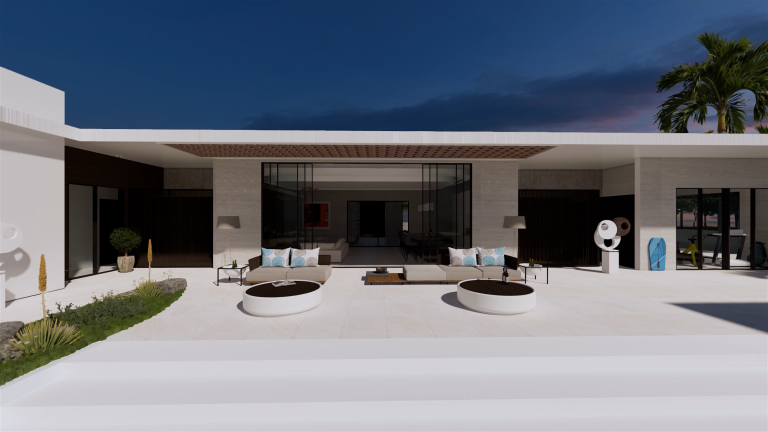
We designed one here ourselves: Pinecrest House, a modern home with a pool and a pickleball court. The brief was to reuse the foundation plan of the house it replaced [11].
Green & outdoors
Trees first
Pinecrest is a Tree City USA community. The village reports planting more than 10,000 street trees since 1997 [2]. Trees are protected. You need a village permit to remove or relocate almost any tree. Specimen trees, over 18 inches across at four feet up, get extra scrutiny [12]. Plan a new house around the canopy, not the other way round.
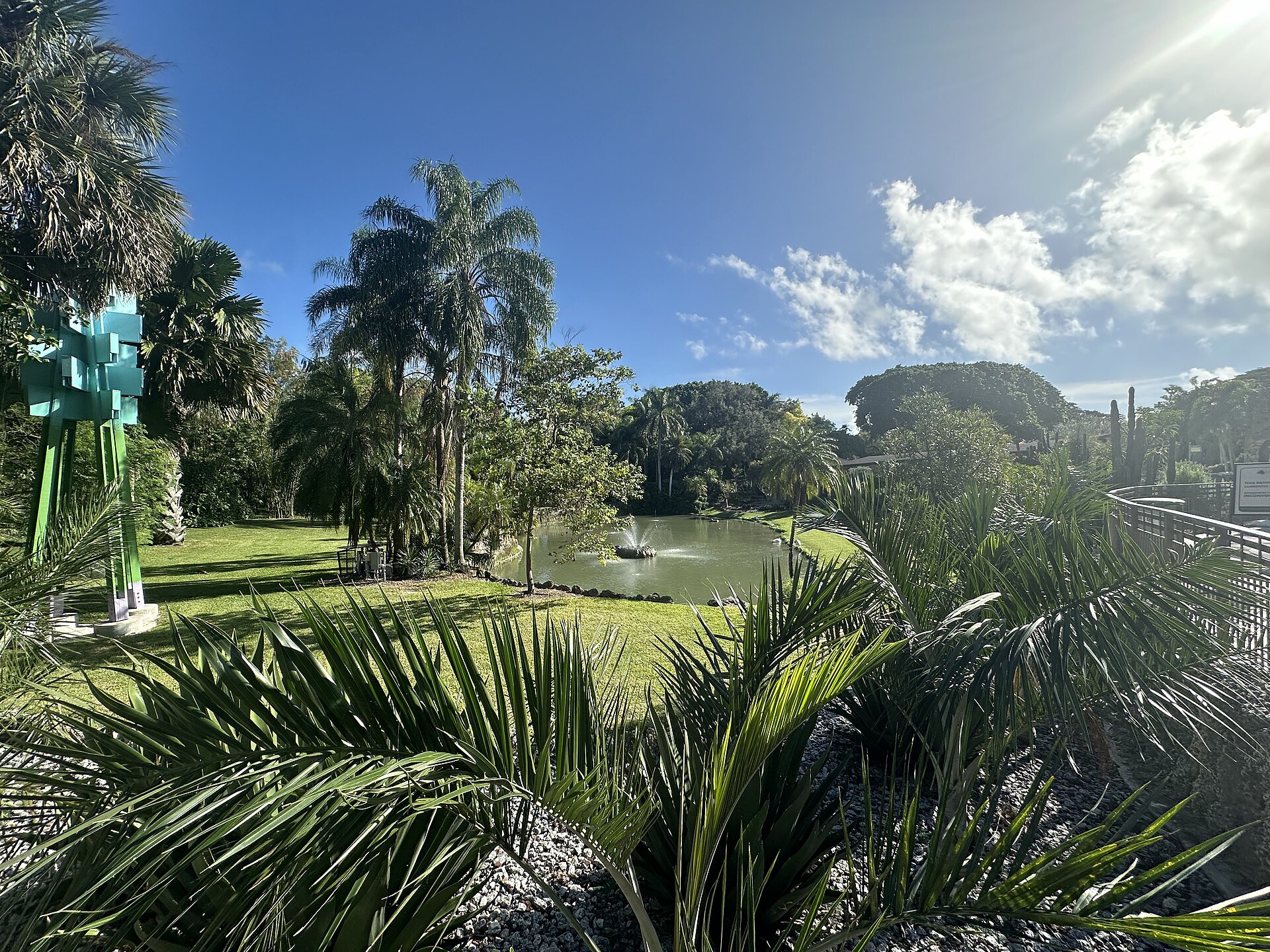
Pinecrest Gardens is the centre of village life. It is the old Parrot Jungle site, opened in 1936. The village bought it in 2002 and opened it as a public park in 2003 [13]. It is on the National Register of Historic Places since 2011 [13]. It holds over 1,000 varieties of tropical plants, a 530-seat domed theatre (the Banyan Bowl), a splash pad and a small zoo [13,14]. A farmers market runs there every Sunday morning [15].
The village also runs five other parks, with sports fields, tennis courts and playgrounds [2].
Families
Schools inside the village
Public schools are run by Miami-Dade County Public Schools. Miami Palmetto Senior High, Palmetto Middle and Pinecrest Elementary are all in the village [2,16]. Attendance zones don’t follow village lines. Check the assigned school for each address with the district [5].
Private schools nearby include:
- Gulliver Preparatory: Upper School in Pinecrest; PK–8 campus on Red Road in Coral Gables. Over 2,200 students [17].
- Palmer Trinity School and Westminster Christian School, both in neighbouring Palmetto Bay [18].
Everyday life
Quiet at home, shops on US 1
Shops and restaurants sit along US 1, called Pinecrest Parkway here, and around Suniland [2,8]. Dadeland Mall is about 9 minutes north [7]. South Miami and Coral Gables are close for more dining. There is no walkable town centre. That is by design.
Before you buy
Flood, wind and insurance
Flood zones vary from street to street. The village has an online tool to look up the flood zone and elevation certificate for each property [19]. The village takes part in FEMA’s Community Rating System, which lowers flood insurance premiums for residents [19,20] to confirm.
All of Miami-Dade faces hurricane risk. In Florida, insurers must offer discounts for wind-resistant features. A wind mitigation inspection documents them: roof attachment, roof shape, opening protection and more [21,22]. Get insurance quotes before you commit. An older house without impact glass and with an old roof can cost much more to insure than a new one [5].
Pinecrest was badly hit by Hurricane Andrew in 1992 and rebuilt [1].
Prices
What homes sell for
- Redfin: median sale price $2,698,715 for the three months ending September 2026, up 7.9% on a year earlier. 66 homes sold in September. Median $887 per sq ft [6].
- US Census (ACS 2020–2024): median value of owner-occupied homes $1,406,400. This is a five-year survey of owners’ own estimates, so it lags the market [3].
The spread is wide. An old ranch house on an acre and a new home on the same size lot can be millions apart. A village-wide median says little about any single house [5].
Next step
Tell us what you’re looking for
Thinking about a modern home in Pinecrest, or building one? We’re happy to talk it through on a video call. For Pinecrest House, the owner shows the house himself. Thinking of another home in Pinecrest? Tell us what you’re looking for.